MIA Talk – The Companies Bill 2013

I will be giving a talk to the Malaysian Institute of Accountants on 17 December 2013 entitled ‘The Companies Bill – Revamping the Companies Act 1965.” The Companies Bill is a significant revamp of the Act and having spoken informally to some of the officers from the relevant authorities, it does appear that they are keen to push through this Bill as soon as possible and to have it tabled before Parliament some time next year hopefully. The version of the Bill I have included in this post is the draft which was released for public consultation. There will likely be a number of amendments (including typographical as well as certain gaps to be plugged) but I expect the main provisions to still remain the same.

MIA

The structure of the talk will cover these topics:

  1. History of the Companies Bill
  2. Incorporation Related Matters
  3. Changes to Filing Requirements
  4. Share Capital
  5. Company Secretaries
  6. Meetings and Written Resolutions
  7. Directors & Auditors
  8. Changes to Capital Reduction

In my slides, I have referenced some background reading material which will shed light on the rationale behind many of the provisions in the Bill. This makes for very useful reading when trying to interpret the Bill. The material are the Consultative Documents (CD) which were issued in 2007 explaining the recommendations for changes to the Act and seeking for feedback. With the responses, the Corporate Law Reform Committee issued its Final Report in 2008.

  1. CD1 General Framework
  2. CD2 Capital Maintenance
  3. CD3 Shareholders
  4. CD4 Liquidation
  5. CD5 Director Duties
  6. CD6 Minority remedies
  7. CD7 Regulatory for Businesses
  8. CD8 Capital Reduction Share Buyback
  9. CD9 Substantial Property Transactions
  10. CD10 Rehabilitation and Receivership
  11. CD11 Sanctions
  12. CD12 Auditors
  13. CLRC Final Report

Liberalisation – Malaysia: Open for Business?

This is an interesting article from the UK Law Society Gazette focusing on the impending liberalisation of the legal market in Malaysia. It features quotes from a number of foreign law firms, and with some mixed reaction on whether the foreign firms will set up here in Malaysia, either through the Qualified Foreign Law Firm route or International Partnership.


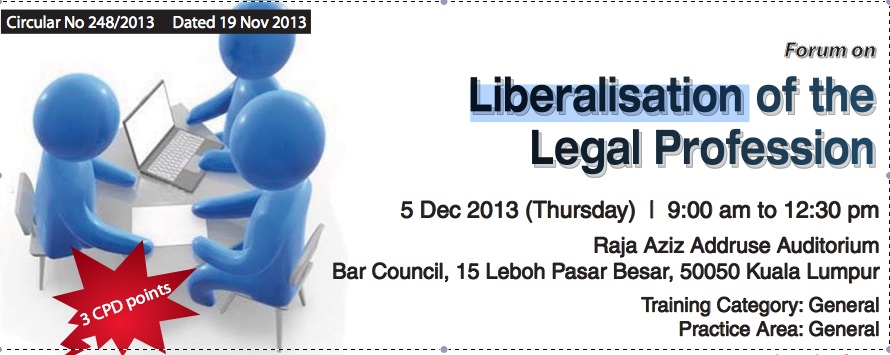
Speaking at the Forum on Liberalisation of the Legal Profession

This Thursday 5 December 2013, I will be one of the speakers at the Bar Council’s Forum on Liberalisation of the Legal Profession. I am to give a young lawyer’s perspective on liberalisation. The registration form can be downloaded here.

liberalisation

I have been following closely the incremental steps forward that Malaysia has been taking towards liberalisation and I wrote about liberalisation earlier. I will be very interested to hear from all the speakers that morning.


Singapore’s Insolvency Law Review Committee Report

When I have the time, I will slowly read through Singapore’s Insolvency Law Review Committee Report (there is also its Executive Summary). I may then highlight some of the more interesting points especially on how the recommendations also reflect on the state of insolvency law here in Malaysia. This is especially pertinent since Malaysia is also undergoing its own revamp of corporate insolvency laws through the Companies Bill 2013. I am just parking the reports on my blog for the time being.

Singapore’s Ministry of Law has also opened the report for public consultation until 2 December 2013 as seen here.

Singapore’s WongPartnership ties up with Foong & Partners

Singapore’s Business Times reports that the Singapore law firm WongPartnership has entered into a strategic alliance with Foong & Partners.

The article quotes the managing partners of both firms:

“This tie-up was driven mostly by the fact that a lot of the work we do today (corporate transactions in Singapore) tends to have a Malaysian component – whether it be an IPO (initial public offering), M&A (mergers and acquisitions) or private equity (PE) deal – because the target may have a business in Malaysia, or the clients may be interested in looking at something in Malaysia, and so on,” WongP’s joint managing partner, Ng Wai King, told The Business Times in an exclusive interview.

Mr Ng said that WongP has been collaborating with Malaysian lawyers on such transactions, including the Temasek Holdings and Khazanah Nasional Berhad joint development in Singapore, the IHH Healthcare Berhad IPO and the Khazanah/Fortis competing takeover offer for Parkway Holdings.

“We find that the need to work and collaborate with strong Malaysian lawyers has become more important now than ever before. Finding the right Malaysian lawyer with the right expertise is very important.

“We have worked alongside FoongP on a number of transactions, including Tune Ins Holdings Bhd’s recent initial public offering, and we found a shared ethos of delivering unstinting high-quality service to our clients,” Mr Ng said.

Foong Chee Meng, managing partner of FoongP, which focuses on high-end corporate commercial, capital markets and corporate finance work, added: “There are a lot of Malaysian clients who are expanding, looking to invest not just in Singapore, but in the UK and Australia, and they’re very aggressive in their expansion. I find that, in most cases, I’ve had to help them and also refer foreign law firms to them. I’ve gone through quite a number of foreign law firms as well and I’ve always enjoyed working with WongP. It makes sense to work a lot closer than before, to have a formal association, whereby we give each other the attention, the priority and the preference.

“Instead of just saying to a client, ‘Look, I think that law firm is good’, I can now say, with a lot of confidence and assurance, that they will get the best service (with WongP). And, if there are any issues, I can just pick up the phone, and so can Wai King; we can call each other and resolve any issues.”

This alliance adds to a growing list of Singapore-Malaysia law firm tie-ups:

1. Allen & Gledhill is associated with Rahmat Lim & Partners.

2. Rajah and Tann is associated with Christopher & Lee Ong.

3. Baker & McKenzie has its Singapore firm Baker & McKenzie.Wong & Leow and Malaysian firm Wong & Partners.

4.  Oon & Bazul is associated with T S Oon & Partners.

5. KhattarWong also has a cooperation agreement with KK Chong & Co.

Winding Up Petitions and Cross-Claims

I came across the unreported case of Josu Engineering Construction Sdn Bhd v TSR Bina Sdn Bhd [2013] MLJU 279 where Mary Lim J made a very thorough analysis of the issue of cross-claims and winding up petitions.This is a rare case where a cross-claim was successful in grounding an injunction to restrain the presentation of a winding up petition, even though the section 218 notice was based on a judgment debt.

There is a seemingly inconsistent position as to whether a genuine cross-claim (which exceeds the initial debt) is sufficient to oppose a winding up petition or to even ground an injunction to restrain the presentation of a winding up petition but this case carefully dissects the different Malaysian appellate authorities as well as other authorities from other jurisdictions.

BRIEF FACTS

The facts in Jose Engineering are important in understanding why the High Court allowed the injunction to restrain the presentation of a winding up petition. The Plaintiff and Defendant were earlier involved in litigation against each other in two different cases, and for ease of reference, I will call them the First Suit and the Second Suit.

In the First Suit, the Defendant succeeded in its counterclaim against the Plaintiff and then issued a section 218 notice seeking for payment under the counterclaim. There was an application filed for a stay of execution but with no hearing date fixed yet.

In the Second Suit, the Plaintiff in turn had obtained a judgment with damages to be assessed by the Senior Assistant Registrar. This was a final judgment as it was upheld by the Court of Appeal and leave to the Federal Court was dismissed. The assessment of damages had yet to be fixed for hearing and with the Plaintiff claiming that it had filed its bundles of documents and had prepared its witness statements. The Plaintiff’s contention is that its claim under the Second Suit judgment would far exceed the quantum of the First Suit’s counterclaim which was claimed in the section 218 notice.

LEGAL PRINCIPLES

The High Court’s analysis of the different authorities ran the gamut from the Malaysian cases of Pontian United Theaters Sdn Bhd v Southern Finance Berhad [2006] 1 CLJ 1067 (C.A.), People Realty Sdn Bhd v Red Rock Construction Sdn Bhd [2008] 1 MLJ 453 (C.A.) and Zalam Corporation Sdn Bhd v Dolomite Readymixed Concrete Sdn Bhd [2011] 9 CLJ 705 (C.A.) (where all the cross-claim arguments were dismissed) to the Singapore Court of Appeal cases of Metalform Asia Pte Ltd v Holland Leedon Pte Ltd [2007] SGCA 6 and Pacific Recreation Pte Ltd v SY Technology Inc & Another Appeal [2008] SGCA 1.

In general, where a debt is undisputed, an injunction to restrain the presentation of a winding up petition is generally refused. And a judgment debt is a clear undisputed debt. However, the High Court found guidance in the Singapore Court of Appeal Metalform decision which allowed an injunction to restrain the presentation of the petition even based on an undisputed debt due to the cross claim. The Singapore Court of Appeal rejected the New Zealand test of having to show that the winding up petition is “bound to fail.” In cross-claim cases, the appropriate test in allowing such an injunction that “there is a likelihood that the petition may fail or that it is unlikely that a winding up order would be made.”

APPLICATION

The High Court noted that unlike the facts before the Court, the earlier Malaysian cases did not involve a cross-claim in the nature of an interlocutory judgment. While the Defendant had a final judgment through the counterclaim, the Plaintiff was also armed with an interlocutory judgment which was also a final judgment. It was only the quantum of damages which had to be assessed. The cross-claim was therefore found to not only be genuine but also bona fide.

The injunction was allowed in restraining the presentation of the petition but on terms that the Plaintiff pay the full judgment sum to its solicitors to be held as stakeholders pending the assessment of damages.

CONCLUSION

This case, and the various authorities referred to in the decision, demonstrate the high threshold to be met in allowing a cross-claim to effectively defeat the right of a judgment creditor to present a winding up petition. This is understandable since the judgment creditor already comes armed with an undisputed debt through the judgment and has a statutory right to present a winding up petition. Whether the petition will be allowed at the hearing is another issue altogether. In litigation, the allegation of a cross-claim is sometimes only raised once the section 218 notice is presented and a cross-claim, exceeding the judgment sum, is cobbled together in order to try to prevent the presentation of the winding up petition.

Essential Tips for Law Job Applicants

CV

I contributed to two articles on LoyarBurok where a group of five of writers shared our views and advice to law job applicants. This was targeted at applicants for pupillage or for junior associate positions, and we shared our tips on the making of the application as well as the interview itself. Definitely worth a read.

The first part of the article is on ‘Essential Tips for Law Firm Job Applications‘ and the second part of the article is on ‘Essential Tips for Law Firm Job Interviews.’

A lot of the tips in there sound a bit basic but time and time again, I see the same mistakes and the same weaknesses cropping up in law firm applications. Recently, I find certain covering emails lacking in formality e.g. “Hi, I am Joshua here” (which is also grammatically wrong) and in another case, I received a Word copy of a CV which still had its changes marked out.

Personal Money – Stuck in a Bankruptcy Quagmire?

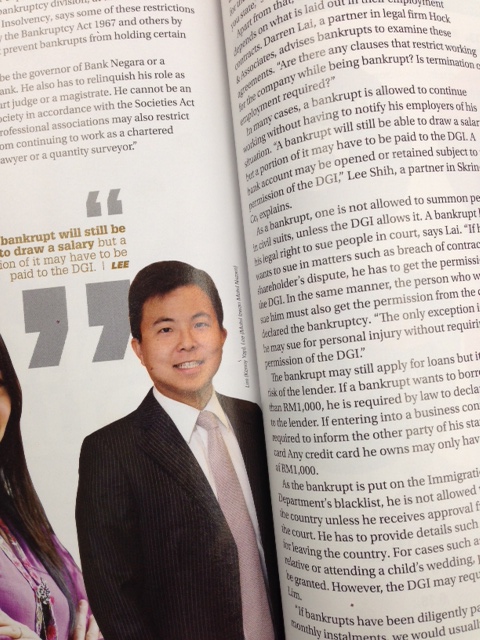
I appear in the November 2013 issue of Personal Money in an article featuring bankruptcy. The article examines a bankrupt’s rights and obligations and how to get out of debt.

photo

It is an interesting article and it features views and commentary from three lawyers, an officer from the Malaysia Department of Insolvency (MDI) and a representative from the Credit Counseling and Debt Management Agency (AKPK). With 113,133 bankrupts recorded by the MDI, the number of bankrupts has been steadily rising over the past few years.