The Royal Commission of Inquiry into the Video Tape: Day 2 Afternoon

The proceedings of the second day of the Royal Commission of Inquiry into the Video Tape resumed at 2.30 this afternoon. I covered the afternoon proceedings for the Bar website, and you can hop over to the Bar website to read Day 1 morning, Day 1 afternoon and Day 2 morning.While the afternoon’s events were mainly focused on the video and audio analysis of the video clips, an interesting exchange was between one of the Commissioners, Datuk Mahadev Shankar, and Thayalan, Counsel for VK Lingam. Read below to find out more.A voice sample of Dato’ VK Lingam had been obtained for a voice comparison with the video clip.

Wan Zulkifli bin Wan Jusoh, the head of the forensic technology division of the ACA, took the stand. The witness testified that he had downloaded a 14-minute long video clip which involved a lawyer on 18 December 2007. On 26 December 2007, under the instructions of Madam Chua Lay Choo, he handed a copy of the video clip on a CD over to Mohamed Zabri Adil bin Talib, an analyst from Cyber Security Malaysia.

The witness also stated that on 11 October 2007, he had also handed over a 8-minute long copy of a video clip over to Mohamed Zabri. This 8-minute video clip had been passed to the ACA by lawyer Sivarasa Rasiah. Having viewed both the 14-minute and the 8-minute video clips, the witness then answered that the 8-minute clip was contained in the 14-minute one.

When queried regarding whether he had received any voice samples on 8 January 2008, the witness answered yes and that he had received voice samples from Moses a/l Lawrence, an ACA officer. The witness continued that he had received one DVD containing 22 voice samples from Malaysian residents, and 1 CD containing Dato’ Lingam’s voice sample. Dato’ Lingam’s voice sample had been obtained by Moses.

When the witness received the DVD, it was marked as “voice samples”, and had both the date 8 January 2008 and Moses’ signature. The witness confirmed the DVD in court and was marked as evidence. The CD was marked as “voice sample 2”, again with the date 8 January 2008 and with Moses’ signature. The CD was marked as evidence.

When the witness was asked about the purpose of these voice samples, he answered that these voice samples were to be handed over to Cyber Security Malaysia in order for them to do a comparison with the voice from the 14-minute video clip.

On 8 January 2008, he had handed over the DVD and the CD to Mohamed Zabri. On the same day, the two of them, along with an ACA officer and two officers from Cyber Security Malaysia, had flown to Agnitio S.L., a biometric laboratory in Madrid, Spain. The purpose of the visit was to conduct a voice comparison in that laboratory. The witness testified that Mohamed Zabri conducted the voice comparison and that the results of the voice comparison were positive.

R. Thayalan then posed a few questions to the witness. The witness stated that he had downloaded the 14-minute video clip from http://www.anwaribrahimblog.com and confirmed that the 14-minute video clip put in evidence was not the original video clip, and was from the internet. He further clarified that nothing had been done to the 14-minute clip to make the image clearer or to improve the audio quality. When queried regarding whether any other tests had been conducted in the Spain laboratory, the witness confirmed that only a voice comparison test had been carried out.

The video clips were authentic

The witness was then released and the fifth witness, Zabri Adil bin Talib, was called. He was a digital forensic analyst from Cyber Security Malaysia. After providing some brief history on his academic and professional qualifications, along with the scope of his work, Zabri confirmed that on 11 October 2007, he received a CD from Wan Zulkifli which was marked as “the CJ Tape”. The CD contained a video clip of length 8 minutes and 20 seconds. On 26 December 2007, he received a CD from Wan Zulkifli which contained a video clip of length 14 minutes and 15 seconds.

On 8 January 2008, he confirmed that he had received a DVD, containing voice samples, and a C, which contained one voice sample. Having examined the DVD and the CD in evidence, the witness confirmed that these were the items he had received, and he confirmed the markings on the DVD and the CD.

The witness then stated that he had done an analysis on all these items, the 3 CDs and the 1 DVD, and had written a report of his findings. The witness then explained that a video analysis had been carried out on both the 8-minute and 14-minute video clips and he had found that these video clips were authentic and had not been tampered with. Further, an audio analysis had been carried out on these video clips and again he found that the audio had not been tampered with. The conclusion, as stated in his report, was that these video clips were authentic.

The witness then gave evidence regarding his trip to the Spain laboratory. He had brought along 2 CDs, a CD – marked as “voice sample 2”, and a DVD – marked as “voice samples.” On 9 January 2008, the voice analysis was carried out at the laboratory. The witness explained briefly on the scientific procedure behind the voice comparison carried out.

The automatic speaker recognition system would compare the ‘unknown voice sample’, being the voice sample taken from the 14-minute video clip, with the ‘known voice sample’, being the voice sample taken from the CD marked as “voice sample 2”. His report stated that the likelihood ratio generated from this comparison was 185 – which fell into the strong support category. The witness explained that such a category indicated that the voice sample was concrete enough to be accepted by a Court. The likelihood-ratio of 185 indicated that the ‘unknown voice sample’ originated from the same source as the ‘known voice sample’.

R Thayalan, Dato’ Lingam’s Counsel: “It looks like him and it sounds like him.”

As R. Thayalan stood up to ask the witness some questions, Datuk Mahadev Shankar then posed the question to Thayalan whether it was his client’s position that he was not the person in the video clip. “Is it him or not him?”

Thayalan then answered that he had been instructed that the person in the video looks like his client and sounds like his client, and that was all.

He would have to take further instructions. Datuk Shankar then posed a second question, that by having read the transcript of the conversation in the video clip, was Dato’ Lingam saying that he did not say what was said in the conversation? The first question was in relation to the image while the second was in relation to the content of the conversation.

Thayalan again had to answer that he had no instructions on this, and he had no answer at the moment.

Tan Sri Steve Shim then interjected and asked Thayalan how could he not have instructions at this stage. Tan Sri Steve Shim pointed out that Thayalan had earlier suggested that the tape was doctored and Tan Sri then queried him whether those were questions were put on instructions. Thayalan answered that his instructions were that part of the tape may have been edited. Datuk Shankar then went on to ask that if Dato’ Lingam has not given instructions, on what basis could Thayalan then proceed to question the witnesses. He answered that he was only questioning on the authenticity of the tape.

Ranjit Singh, Counsel for the Bar Council, then asked the witness a question as to whether the witness was aware that the ‘known voice sample’ was that of Dato’ Lingam. The witness then answered that he was not aware.

Tan Sri Steve Shim referred the witness to the summary of his report, which made reference to facial recognition technology. The witness clarified that while America had facial recognition technology, Cyber Security Malaysia has yet to purchase such technology. In answer to whether it was possible to send the video clip over to America, the witness answered that it was not as simple as that, as they would have to establish contacts like they did for the Spain laboratory.

The proceedings continue tomorrow morning with further questioning of the witness.

Singapore Law Watch

Do check out Singapore Law Watch, a recently launched legal news syndication site. It is great in that it consolidates all the daily legal news headlines, as well as providing links to the latest cases and more interestingly, the legal commentaries.I had already been regularly downloading Singapore law firms’ e-newsletters to read about the latest case law developments.

Blitzkrieg Ex Parte Appointment of a Provisional Liquidator

Introduction

A provisional liquidation is the Court appointment of a liquidator to a company in the period between the filing of the application to wind up the company and the Court hearing the application, pursuant to section 231 of the Companies Act 1965 (“the Act”) and Rule 35 of the Companies (Winding Up) Rules 1972 (“the Rules”). The appointment is provisional because the company may not be wound up at that hearing, or another official liquidator may be appointed.

The effect of the appointment of a provisional liquidator is that the powers of the board of directors immediately cease, and the powers of managing the company vests in the provisional liquidator. A sudden ex parte (i.e. without any notice being given to the other party) appointment of a provisional liquidator over a company allows the provisional liquidator to show up at the doorstep of the company’s office, the Order of appointment in hand, and proceed to lock up the office and seize control of all documents, assets and property of the company.

Depending on the circumstances, the terms of the ex parte Order may even allow the provisional liquidator (and his representatives) to enter the homes of the directors or any other place to seize company documents, if there are grounds to believe that these company documents have been secreted away.

The business of the company may well be paralysed as the provisional liquidator may or may not continue with the running of the company. Additionally, there may be irreversible damage to the goodwill and reputation of the company.

The ex parte appointment is normally based on the justification that the assets and affairs of the respondent company are in jeopardy. Such appointment is made to ensure that the assets and property of the respondent are under the control of the provisional liquidator until the determination of the winding up petition. Hence, any notice given to the respondent might result in a dissipation of the assets before the provisional liquidator is appointed.

The ex parte appointment is normally based on the justification that the assets and affairs of the respondent company are in jeopardy.

The ex parte appointment of the provisional liquidator lasts until the disposal of the winding up petition and even then there is no automatic right to an inter partes hearing. Hence it is crucial for the respondent company to quickly apply to set aside this ex parte appointment or the company will continue to be paralysed.

There are several grounds the respondent can rely on, namely:

(i) Failure to Show a Good Prima Facie Case for Winding Up

As held in the case of Kok Fook Sang v. Juta Vila (M) Sdn Bhd [1996] 2 MLJ 666, a court will only appoint a provisional liquidator upon the presentation of a winding-up petition when there is good prima facie evidence that the company will be wound up because the company is obviously insolvent, or its assets are in jeopardy or there are other circumstances which make it imperative for the court to intervene.

It was further held that the primary facts set out in the petition if assumed to be true and the uncontested evidence taken as a whole must add up to the conclusion that it is imperative that the winding-up order be made. Therefore, the respondent in applying to set aside the ex parte appointment must demonstrate that there is no good prima facie case for winding up, and that the allegations in the winding up petition do not support a winding up order. This is illustrated in the case of Re Lo Siong Fong [1994] 2 MLJ 72 where the petition had no hope of being successfully prosecuted, and the appointment of the provisional liquidator was set aside.

(ii) Failure to Make a Full and Frank Disclosure of Material Facts

The respondent can challenge the appointment of a provisional liquidator on the ground that there has been material non-disclosure during the ex parte hearing. Malaysian cases like Re Lo Siong Fong [1994] 2 MLJ 72 and Kong Long Huat Chemicals Sdn Bhd v. Raylee Industries Sdn Bhd [1998] 6 MLJ 330, and the Singapore case of Pac Asian Services Pte Ltd v. European Asian Bank AG [1989] 3 MLJ 385 involved material non-disclosures of facts during the ex parte hearing that led to the setting aside of the appointment of the provisional liquidator.

In the English case of Siporex Trade v. Comdel [1986] 2 Lloyd’s Rep 428 the Court held that the applicant must identify the crucial points for and against the application, and not merely rely on general statements and the exhibiting of numerous documents.

This duty of disclosing material facts also extends to the oral hearing of the application itself. In the English case of Memory Corporation Plc v. Sidhu (No. 2) [2000] 1 WLR 1443, the Court made a general statement regarding urgent without notice hearings; that there is a high duty on the advocate to make full and frank disclosure and that extends to the oral hearing of the application itself. The advocate must draw the court’s attention to the unusual features of the evidence and to the applicable law.

(iii) Balance of Convenience

The onus is on the petitioner to establish the urgency and need for the appointment of a provisional liquidator and the Court must have regards to the balance of convenience due to the devastating effect on the company.

Further as held in the Australian case of Zempilas & Ors v. J N Taylor Holdings Ltd & Ors (1990) 3 ACSR 518, the appointment of a provisional liquidator is not to be contemplated if other measures would be adequate to preserve the status quo. Hence, alternative measures in preserving the status quo would shift the balance of convenience to justify the setting aside of the appointment of the provisional liquidator.

(iv) Failure to Give Undertaking for Damages?

Even if the petitioner had failed to give an undertaking for damages in the ex parte application for a provisional liquidator, it appears that this is not a ground to support a setting aside application.

In Pui Chiau Tien v. Foi Chaw Leong & Anor [2004] 5 CLJ 145, the Court considered the contrasting decisions of Eveready Manufacturing (Pte) Ltd v. Explast Industries Sdn Bhd [1998] 5 CLJ 212 and Kong Long Huat Chemicals Sdn Bhd v. Raylee Industries Sdn Bhd [1998] 6 MLJ 330 and clarified that the undertaking in damages by the applicant is not mandatory in an ex parte application for the appointment of a provisional liquidator but it is customary and in accord with general practice. Section 231 of the Act and Rule 35(1) of the Rules do not lay down the requirement that there must be an undertaking as to damages before the appointment of a provisional liquidator. It is entirely up to the court’s discretion and the absence of such an order for undertaking as to damages does not in any way invalidate the Order.

…the setting aside may well represent a hollow victory…

Although the above factors justify the setting aside of the ex parte appointment of a provisional liquidator, it may take a long time to achieve this. Thus, the setting aside may well represent a hollow victory as the respondent company may already have suffered irreparable damage to its business i.e. its business would be suspended and bank accounts frozen during that period.

The true security of companies against the ill-effects of the unjustified ex parte appointment of a provisional liquidator thus resides in the vigilance of the Court in determining whether the grounds in support of the ex parte application truly warrant the appointment of a provisional liquidator.

Bonuses for Singapore lawyers hit 9 months

The Straits Times reported today of the large bonuses being paid out to the top performing lawyers, it being a reflection of the booming business the law firms are experiencing.

BIG law firms, buoyed by the business boom, are handing out bigger year-end bonuses this year, with the best payouts breaching the nine-month mark.

The Straits Times understands that top performing lawyers in top-league firms like Drew & Napier and Rajah & Tann are getting high payouts across the board as rewards to recognise good work when the going is good.

Other firms like Harry Elias Partnership (HEP) and KhattarWong also awarded fatter bonuses of between 5-1/2 and eight months to its lawyers.

HEP’s managing partner Latiff Ibrahim said its top performers are in the ‘booming corporate, construction and litigation practices’.

KhattarWong’s Subhas Anandan said the bigger bonuses also spilled to the non-legal support staff, with the best receiving up to 5-1/2 months.

Lawyers generally attributed the fat bonus cheques to the strong economy, increased revenues and the need to pay high performers for ‘all the hard work and all the nights they have put in’.

WongPartnership, one of the biggest firms here, has had an ‘extremely good year’ in terms of the transactions and briefs received, said Mr Chou Sean You, a partner in the firm.

‘We expect to remunerate our lawyers well for all the hard work they have put in throughout the year,’ he said, adding that his firm traditionally declared its bonuses in January.

The upturn has benefited small and medium-size firms as well, especially in conveyancing work, said senior lawyer N. Sreenivasan.

‘Whether the property boom continues into the new year remains to be seen,’ he added.

He said that ‘with expected rental and salary increases next year, law firms will have to be more efficient, to reduce the impact of these increased overheads on the cost of legal services’.

Small firms which may not be able to match the fat bonuses of their bigger counterparts are unfazed, with some noting the hidden toll in work-life balance for those working in the top league.

Said Mr R. Kalamohan, who has run his own firm for more than 18 years: ‘I don’t know how many ‘handicaps’ I have compared to big firms, but when you look at the work-life balance, it is a different issue.

‘I am not constrained to burn the midnight oil every day unless there are exigencies. I do not think income is the main criterion for a good life.’

I think the Malaysian law firms generally had a good 2007 as well, with law firms paying out good bonuses. Not quite in the same bracket as 8-9 months of course.

How to Become a Partner

An interesting interview with Jon Holland, a partner specialising in banking disputes at Lovells.I reproduce the article from Times Online below:

You have to want it. Which means that you need to enjoy what you’re doing. Specialising in an area that you’re interested in plays a big part. This may sound extraordinary, but I get out of bed each morning and look forward to coming into work. And that’s not because I don’t get on with my wife or I hate my kids.

We work in a service industry. Accept it. My dad worked in a chocolate factory. He’d leave home ten minutes before his shift started and be back ten minutes after it finished. The boundaries as a City lawyer are somewhat less distinct. At Easter, we had a crisis on a job. I was on holiday with my family at the time. I flew back immediately, arriving in the office direct from the airport early in the morning on Good Friday. The next time I went home – other than to grab four hours sleep here and there – was May 1. Of course, it’s not just about working your nuts off every day.

Learn to delegate. Where a lot of lawyers come unstuck is not being able to handle several things at the same time. It’s something that you notice when associates are four to five years qualified and the level of responsibility has been cranked up a notch. Being able to prioritise is obviously useful, but the real trick is to delegate. Secondments – on which junior lawyers typically enjoy added responsibility – are a good opportunity to get some practice at that. After I qualified in 1998, I spent three years in Lovells’ Hong Kong office, where I was supervised with a very light touch. I felt slightly at sea on occasions, but gradually learnt that I could save myself a lot of time by trusting certain tasks to junior colleagues. It’s not easy at first, but letting go of total control over everything is the only way to keep all the plates spinning.

“Hello! You don’t know me, but how about lunch?” Partners have to be self-sustaining. So it’s essential to demonstrate a capacity to bring in work. Still, nobody is expecting associates to cold call the general counsel of a leading corporate. There’s no magic to business development. It’s just about being yourself and gradually building relationships with the people who you get on with. I have strong ties with clients as diverse as Barclays Capital and the Bank of Zambia that date back to my days as a fairly junior associate.

Remember, you’re a lawyer first; businessperson second. As a lawyer, your professional reputation is the most valuable asset that you have. The good associates never assume any facts or legal theories that they’re not absolutely certain about – whatever wider pressures they’re facing.

You’re not going to get partnership just because you’re a really fun person. That doesn’t mean that fitting into the culture of the team isn’t important. Small things count. A few months ago I had several associates over to dinner and they read my kids a bedtime story. Sometimes it’s just sharing a conciliatory glass of wine with colleagues after a terrible day.

Be prepared to move. People can have all the credentials and not make it simply because there is a dip in the practice area, or sometimes just a glut of very good people. In those situations it’s worth considering moving to another firm.

What glass ceiling? Eighty-five per cent of the lawyers on my team are female. The most recently made up partner in the group is a woman. And we’re seeing more and more female partners filtering through the system. In my experience, women are often better at the interpersonal skills that are becoming increasingly important to law firms. My wife is certainly less shy than me at parties.

Keep going! When I was first put forward for partnership back in 1996, I didn’t get it. I was rather disappointed to put it mildly. There may even have been a few bins kicked. But I persevered and the next year I was successful.

Let me just add some of my observations on some of the issues raised. I would think that the advice provided by Holland would equally hold true in law firms everywhere.

I think for anyone to stay in the legal profession in the long-haul, to aim for partnership, you really need to enjoy what you are doing. Not just the general practice of law, but also the field of specialisation you are in.

Holland did touch on the issue of the ability to bring in work. My impression is that this could be one of the major prerequisites in making the jump to partnership (equity partnership that is). If you have already become a senior associate or a salaried partner, I think it can be assumed that you are a good lawyer and hard worker. But you will still have to be able to bring business to the firm, so relationships all start while at the associate level. Your university friends, other associates at the same junior level as you in banks, accounting firms, public listed companies. All of them will grow up with you, and rise in rank with you, in the years ahead.

It was also pertinent to raise the issue of the glass ceiling. Look at the present demographics for law students and young lawyers entering the profession. The percentage has now tilted to more than 60% of females entering the profession. It is fantastic that more and more females will enter, stay on in the profession, and become partners.

Bristol-LSE Debate: The Aftermath

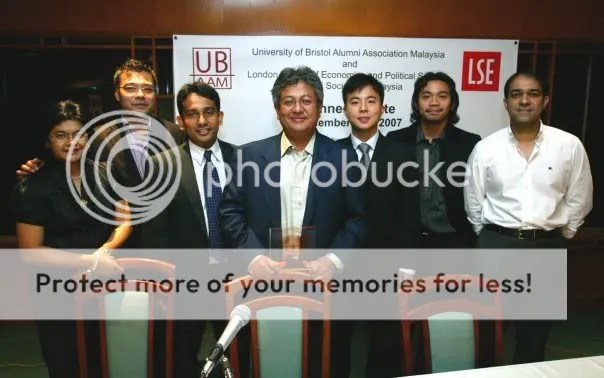
I had great fun this evening at the debate. It was staged at the Royal Selangor Golf Club, deep in Kuala Lumpur. There was a really bad jam leading there, and I was worried about reaching there late. I wasn’t in the most prepared of states, and was quite stressed with preparing my debate, whilst juggling the clearing of work this week before I went on leave.

Although I knew only one person at the dinner initially, I soon got to know the people on my table quite well, and while there were several pockets of LSE alumni as well as Bristol alumni, people were generally mixing well.

Photo Sharing and Video Hosting at Photobucket

Having completed our 6-course dinner, it was time to start the debate proper. We were very fortunate to have Datuk Zaid Ibrahim to moderate the debate. The debate was generally a light hearted affair, and it was quite interactive where the audience members would react and cheer their unimate on, or boo the other side, but all in good fun. Each round would be decided by way of vote of hands from the floor.

The debate kicked off with the first topic: “This house believes that the British university environment and standards can be recreated in Malaysia at local institutions of higher learning.” LSE was proposing this motion, while Bristol was opposing, and Bristol won this round.

The second topic was “This house believes that both universities attract diverse students, but while Bristol produces all-rounders, LSE churns out financial stereotypes”, with Bristol proposing. For this round, LSE edged out the Bristol side and therefore it all came down to the final topic.

“This house believes that football as a sport does more for youth development than motorsports.” This is the one which I had to tackle and I went first in advancing the proposition. Nerves definitely kicked in, and while my prepared opening went smoothly, I definitely didn’t do as well during my rebuttal section, but I managed to salvage it during the conclusion I guess. I think it is fair to say, and this was commented by a neutral member of the audience (Exeter alumni), that both speakers had rather porous arguments which he could poke holes through.

The moderator graciously declared the round a tie, although I think the show of hands was in favour of LSE. Therefore, the night ended in a tie. The overall score between Bristol and LSE would officially read 1/2 – 2 1/2.

But again, the whole evening was in good fun and spirit, and I am glad that I got involved in the event. I made quite a number of new friends, both Bristolians and LSE-ians, especially over drinks after the event. The Bristolians would be reminiscing about our Bristol days, asking which hall did we stay in our first year (seems like the nickname Shiat Bunker has been around for many years even before I was there), remembering the Downs, Whiteladies Road and Blackboy Hill (not the most politically-correct street names I must admit). Looking forward to the next alumni event.

Photo Sharing and Video Hosting at Photobucket

Bristol-LSE Alumni Debate

I was invited to take part in the Bristol-LSE Debate tomorrow evening. It is being organised by the University of Bristol Alumni Association of Malaysia and it revives the friendly rivalry between the two alumni associations here in Malaysia (Bristol is now trailing 0-2 after losing in paintballing and go-karting).

I will be in the company of real heavyweights while I will be the small fry. On the Bristol team, there will be Fahri Azzat, a prominent young lawyer, as well as Dato’ Ahmad Zaki Zahid, Head of Policy Unit in the PM’s Department.

On LSE’s side, there will be Raja Eileen, a partner from the law firm Raja, Darryl & Goh, and Dato’ Azman Yahya, former CEO of Danaharta. Originally Dato Tony Fernandes (of Air Asia) was also supposed to debate for LSE but I’ve been informed that he might have to pull out.

The debate will be carried out in the Economist Oxford 2.0 format, with slight tweaks.

For each topic (25 mins):

1. Intro by moderator – 1 min
2. Proposal opening – 3 mins
3. Opposition opening – 3 mins
4. Proposal rebuttal – 3 mins
5. Opposition rebuttal – 3 mins
6. Proposal conclusion – 2 mins
7. Opposition conclusion – 2 mins
8. Moderator summarises – 3 mins
9. Floor votes and vote-counting – 5 mins

It will be much faster than a standard debate, and it will be individual speakers against individual speakers, and not a team event. So there will be 3 topics up for debate.

Mine is the more light-hearted of the three: “This House believes that football as a sport does more for youth development than motorsports.” Luckily, I am on the proposition side, and I think the topic is quite heavily tilted to the proposition’s favour.

My opponent? Dato’ Azman Yahya. Good luck to me. I am stressed.

Quite short notice, but if anyone has any ideas in support of my topic, or if you can anticipate points raised in favour of the opposition, please drop a comment. Much appreciated!

Changes to the Singapore Legal Market: Part II

I touched on the changes to the legal education and admission to the legal profession in Part I of this post. In Part II, I hope to highlight some of the aspects of the further liberalisation of Singapore’s legal sector.One of the significant changes is that foreign firms will be allowed to completely set up on their own and to advise on Singapore law. There are also further changes to the present Joint Law Venture scheme to make it more attractive for foreign firms to partner up with local firms.

Present System Involving Foreign Law Firms

The Committee to Develop the Singapore Legal Sector, headed by the Judge of Appeal Justice VK Rajah, first reviewed the present system in Singapore in relation to foreign law firms. The Committee took note of the fact that the number of foreign law firms based in Singapore have remained more or less stagnant over a 10-year period. As of 31 July 2007, there were 72 foreign firms with 645 foreign lawyers. While these foreign firms have offices in Singapore, the lawyers in their Singapore operations are restricted from practicing Singapore law and are not permitted to appear in court. This situation was described as a ‘parallel dimension’ – where the foreign firms are physically in Singapore but not connected to or engaged in the Singapore legal system.

…there has been a steady stream of Singapore-qualified lawyers migrating to join the foreign firms both in their overseas offices and the Singapore offices.

The Committee noted that notwithstanding the inability to practice Singapore law, there has been a steady stream of Singapore-qualified lawyers migrating to join the foreign firms both in their overseas offices and the Singapore offices. The often quoted reasons are to gain better international exposure, better pay and career prospects and improved working hours. The statistics reveal that in 2001, there were 61 Singapore lawyers who had left the profession to move to a foreign firm in Singapore, and by February 2007, this number nearly doubled to 119. These numbers do not include lawyers who had left to practice directly overseas.

The present closed market also does not encourage these foreign firms to advise clients to adopt Singapore law as the governing law of their regional/international transactions.

The Committee noted that the Joint Law Venture scheme, in which a foreign firm partners with a local firm, has been of limited success and while the JLV was intended to provide a one-stop shop to clients, it has not always worked out to be so in practice. I have blogged about the high-profile departure of Freshfields from its JLV association.

Proposed Changes

The major shake-up would be that up to 5 foreign law firms, dubbed Qualifying Foreign Law Firms (QFLFs), will be allowed to employ Singapore-qualified lawyers to practice Singapore law in all areas except for litigation and general practice. Therefore, this encompasses the high-end corporate work, arbitration and maritime areas of practice. The practice of criminal law, retail conveyancing, family law, administrative law and all aspects of commercial litigation will be ring-fenced.

The present JLV scheme will also be tweaked to the Enhanced Joint Law Venture scheme. There will be a relaxation on the restrictions of profit sharing and the foreign law firm will also be allowed to hire Singapore-qualified lawyers to advise on Singapore law.

At a macro level, it may pave the way to an increase in volume and quality of high-end transactional work going to Singapore. At a micro level, it may help stem the tide of lawyers leaving Singapore to work in other financial sectors. Singapore lawyers can work in these approved foreign firms and obtain exposure to high-end international work.

The Committee was also guided by the Hong Kong experience in liberalising its legal market. Despite the rising number of foreign firms and foreign lawyers in Hong Kong, the number of local firms and local lawyers have also risen. Therefore, liberalisation need not be at expense of local legal community. In fact, one commentator attributes Hong Kong’s sterling reputation as the region’s legal hub to its far-reaching liberalisation, as compared to Singapore’s.

“Perhaps the real question to be addressed is not whether Singapore should take this step forward but how quickly.”

In relation to the liberalisation of the legal market, the Committee stated that: “Perhaps the real question to be addressed is not whether Singapore should take this step forward but how quickly.”

Some Thoughts

From the perspective of a young lawyer, there will be an increase in the options available, with the attractive avenue of working for a foreign law firm, enjoying an international exposure while still retaining a Singapore practicing certificate. As commented by the Ashurt Singapore managing partner: “The proposed changes also look very positive for young local lawyers, giving them an opportunity to continue to practice Singaporean law while having the platform of an international firm to work on exciting transactions regionally and globally.”

It will make the competition for legal talent all the more heated, with the local Singapore firms possibly losing more lawyers to the foreign firms.

It remains to be seen whether Singapore’s plans for liberalisation goes far enough to attract the foreign firms. It seems that the UK firms have been lukewarm in response to the proposed changes.

Changes to the Singapore Legal Market: Part I

It was announced todaythat the Singapore Government has accepted, in principle, the recommendations made by the Committee to Develop the Singapore Legal Sector.The Committee made far-reaching recommendations to improve the entire legal services sector. One of the more significant proposals relate to a further liberalisation of the legal sector to not only enhance the present Joint Law Venture scheme, but to also full-out allow foreign law firms to practice Singapore law in certain commercial areas. This area I hope to cover in more detail in Part II of this post.

Part I will however deal with another significant area, that of a review of the present legal education system and admission procedures to the legal profession.

(i) 3-year LLB course

The Committee took note of the fact that there were strong arguments to support the reduction of the present 4-year LLB programme to only 3 years and recommended that the law schools consider, at an appropriate juncture, to offer a 3-year undergraduate programme.

(ii) Vocational Training Course

Next, the Committee recognised the weaknesses in the present Practical Law Course (PLC). It did not act as an effective gatekeeper as nearly all the students entering the course would pass the course. It also did not allow any scope for specialisation as all the subjects are compulsory. The Committee also received anecdotal feedback that the Graduate Diploma in Singapore Law (DipSing) had outlived its utility. The course could be unproductive as it often repeats the content of courses from overseas, with a slight local flavour.

The emphasis of the new Vocational Training Course would be on imparting practical skills

To address these problems, the Committee recommended the replacement of the PLC with a new Vocational Training Course (VTC). The duration of the course would be for 6 months, but ultimately it could be increased to a year. The emphasis would be on imparting practical skills as well as allowing students to tailor their own courses and to specialise in subjects such as advanced civil and criminal procedure, litigation skills, admiralty law, corporate practice and corporate restructuring.

I would imagine this new proposed VTC would be akin to the English Bar Vocational Course and the Legal Practice Course.

The Committee also suggested for the DipSing to be abolished and that eligible graduates from the recognised foreign universities would take additional modules introducing them to Singapore law, in a practical context. In time, it may be necessary to introduce a local VTC for the graduates from the local universities, who are already trained in Singapore law, while having a verson of the VTC for foreign graduates. Eventually, it is envisaged that the Vocational Training Course would have the same cachet for lawyers wishing to practice in the region as the New York Bar exam is to lawyers worldwide. Maybe slightly over-ambitious, but still a move to be lauded.

(iii) Training Contract to Replace Pupillage

There is also the recommendation to restructure the present pupillage system to a training contract one. It is hoped that the training contract will oblige firms to engage its trainees in a structured learning programme, and there is the recommendation that there be a rotation among the departments. This could be more of a cosmetic change than anything else. The training contract period will still be maintained at 6 months (whereas the UK has a 2-year period) and I would imagine most of the pupillages are already very similar to the proposed training contract.

Sadly, when looking closer at home, Malaysia does not appear to be making any progress in enhancing its legal admissions system or resolving the present trichotomy – the local graduates forming one part, UK Bar graduates skip straight into pupillage without training in Malaysian procedure, while other graduates are forced to go through the grind of the CLP (more on the complaints surrounding CLP over here). I have also written in the past on the weaknesses of the present pupillage system in Malaysia.

Injunction to Restrain Filing of a Winding Up Petition

In light of a few recent Court of Appeal decisions, it is useful to set out the position in law regarding an injunction to restrain the presentation of a winding up petition.A filing of a winding up petition is often used by a creditor as a means to exert pressure on the company to pay its debt. As the presentation of such a petition must be advertised, this would have an adverse impact on the financial standing and the reputation of the company, and may also result in the freezing of the company’s bank accounts.

The companies court should not be used for the collateral purpose of pressuring a company to pay a disputed debt and the law allows the company to apply for an injunction to restrain the filing of such a petition.

When a court restrains the presentation of a winding up petition to that court it exercises part of its inherent jurisdiction to prevent abuse of its process.

Prior to the filing of a winding up petition based on a debt, a creditor must issue a notice (often described as a Section 218 Notice) giving the company 21 days to pay the sum demanded . If this debt is disputed, it is within this crucial 21-day period that the company must then apply for an injunction to restrain the filing of the winding-up petition.

Inherent Jurisdiction of the Court

There is no specific provision under the Companies Act or the Companies (Winding-Up) Rules which allows for such an injunction. The Court exercises its inherent jurisdiction to prevent an abuse of its process when it issues such an injunction. As recognised in Fortuna Holdings Pty Ltd v The Deputy Commissioner of Taxation of the Commonwealth of Australia [1978] VR 83:

When a court restrains the presentation of a winding up petition to that court it exercises part of its inherent jurisdiction to prevent abuse of its process. Mann v Goldstein, [1968] 1 WLR 1091, at pp. 1093-4; [1968] 2 All E.R. 769.

Usually a court acts against abuse of its process after proceedings have been commenced. Thus, existing proceedings may be stayed or dismissed, or documents delivered as a step in the proceedings may be struck out. This is done to relieve a party to the proceedings from an oppressive and damaging situation in which he has been placed through abuse of court process.

The law has long recognized that with proceedings to wind up a company, intervention after the commencement of proceedings would often be too late to relieve the company of oppression and damage. The courts have recognized that irreparable damage may be done to a company merely through public knowledge of the presentation of a petition. Usually the damage flows from the loss of commercial reputation which results. The courts have also been conscious of the pressure which may be put on a company, by a person with a disputed claim against it, threatening to present a winding up petition unless the company meets his claim. While that threat exists, the company, in order to avoid the damage involved in the presentation of a petition, is pressed to meet the claim although it may have substantial and genuine grounds for regarding itself as not required to do so.”

…the test to be applied is whether there is a bona fide dispute of debt based on substantial grounds.

‘Bona Fide Dispute of Debt on Substantial Grounds’

The position under Malaysian law has been confirmed in the Court of Appeal case of Tan Kok Tong v Hoe Hong Trading Co Sdn Bhd [2007] 4 MLJ 355 where the Court quoted with approval the above passage. When deciding whether to grant an injunction to restrain a petition that is based on a statutory demand for a debt, the Court must be satisfied that there is a prima facie case and not merely a serious issue to be tried. In demonstrating this prima facie case, the Court of Appeal held that the test to be applied is whether there is a bona fide dispute of debt based on substantial grounds.

This helps to clarify the somewhat conflicting High Court authorities which held that the test in granting such an injunction is whether the winding up petition is bound to fail (for instance, see Sri Binaraya Sdn Bhd v Golden Approach Sdn Bhd [2000] 3 MLJ 465 and as discussed in Pembinaan Lian Keong Sdn Bhd v Yip Fook Thai (practising as Messrs Yip & Co) [2005] 5 MLJ 786).

For a creditor to resist such an injunction and to demonstrate that there is no ‘bona fide dispute of debt on substantial grounds’, a creditor should come armed with a judgment sum or with a clear admission of debt (as seen in the Supreme Court case of Chip Yew Brick Works Sdn Bhd v Chang Heer Enterprise Sdn Bhd [1988] 2 MLJ 447).

Injunction to Restrain Advertisement of Petition?

If the petition has been filed, can the company apply for an injunction to restrain the creditor from advertising the petition? In Chip Yew, the Supreme Court refused to grant an injunction to restrain the advertisement and this was similarly followed in the High Court decision of Azman Tay & Associates Sdn Bhd v Sentul Raya Sdn Bhd [2002] 2 MLJ 395.

…once a winding-up petition is filed, the court is precluded from granting an injunction against advertisement or gazettal of the petition.

Now, the Court of Appeal in People Realty Sdn Bhd v Red Rock Construction Sdn Bhd [2008] 1 CLJ 632 has confirmed that once a winding-up petition is filed, the court is precluded from granting an injunction against advertisement or gazettal of the petition. (Ed: The Appellant’s leave to appeal to the Federal Court was dismissed. Hence, the case of People Realty continues to remain as binding authority on this point)

This Court of Appeal decision must surely lay to rest the anomalous High Court decision of Celcom (Malaysia) Bhd v Inmiss Communication Sdn Bhd [2002] 3 MLJ 178 where the Court granted an Erinford injunction to restrain the advertisement and gazettal of the petition. People Realty confirms the mandatory requirements of advertisement and gazetting as set out in the Companies (Winding-Up) Rules.

Echoing the words of Vincent Ng J (as he then was) in Azman Tay, “…the court is not empowered to make any order to restrain or injunct the petitioners from carrying out their statutory obligation to comply with r.24.

This makes it even more imperative for the company to obtain an injunction during the 21-day window after the issuance of the Section 218 Notice, since the filing of the petition would prevent any injunction restraining the advertisement and gazetting of the petition.